Friday, July 01, 2016

Money matters

There are lots of things you have to learn about money in Peru besides where to get a good exchange rate for your dollars.  The standard currency in Peru is the Nuevo Sol.  Right now a dollar will buy about 3.3 soles -- near the all time high of 3.5.  Coins come in denominations of 5, 10, 20 and 50 centimos (cents), and 1, 2 and 5 soles.  Bills come in demoninations of 10, 20, 50, 100, 200 and probably larger ones that I've never seen.

Coins of 5, 2 and 1 nuevos soles
When you withdraw money in soles from an automatic teller machine, you generally get bills of 50 and 100 soles.  But unless you live in an expensive neighborhood and shop only at the malls and supermarkets, the vast majority of your transactions are with small, one-person stores in the markets, and with taxi drivers.  They tend not to have change for anything larger than 5 or 10 soles.  So you have to always think ahead and try to keep a few small bills in your wallet.  Whenever I go to a large store, I always pay with my larger bills of 50 or 100 soles, no matter how much the item costs, because I know they have plenty of change and won't complain.

Another money issue you have to deal with is counterfeiting.  Both coins and bills are often counterfeited here, so vendors are always on the lookout and carefully examine every bill and coin you give them.  If a bill has the smallest tear in it, they won't accept it.  (The central bank will accept them, so they're not worthless, but who wants to go downtown just to change a bill?)

Yesterday I tried to pay for an ice cream cone and was told that my five sol coin was counterfeit.  I compared it to another that I had, examining every detail, and couldn't see any difference, so I thought the vendor was just being overly cautious.  I tried to use it for another transaction later, and it was again rejected.  So I asked the vendor how she could tell it was false.  She told me that it didn't feel like a real coin -- its surface was rough instead of smooth.  And I had to admit that she was right.

The other big issue is the banks.  There is plenty of competition in Peru, with lots of international banks and many large national ones.  But that doesn't mean that banking is easy or inexpensive.  Sonia opened a savings account here at Scotiabank when we arrived, because they belong to a network of international banks that waive transaction fees at the ATMs of all of the banks in the network.  They created two accounts for us -- one in soles and one in dollars.  We can freely transfer money between the two, but the exchange rate on transfers is about 3% less than the market rate.  So in order to take advantage of the currently high exchange rate, we have to wire our money in dollars from the U.S. (which costs us half a percent on each end), then withdraw the money from the bank, carry it across the street to a money changer -- who will give us a slightly better than market rate if we're exchanging thousands of dollars -- and then carry the soles back to the bank to deposit them.

Saturday, June 25, 2016

Getting to know Huaraz

Huaraz is a small town in Peru (120,000 people) about 250 miles northeast of Lima that lies at 10,000 feet in the tropical zone (10 degrees south of the ecuator) -- probably one of the few places where you find palm trees growing at this altitude!  It starts to get cold as soon as the sun sets, down to about 40 degrees in the middle of the night, but then warms up quickly after the sun comes up, to a little over 70 degrees.  And the sun is intense at this altitude, so it feels much hotter than 70.  If you need to go out early, you put on a couple of extra layers and then pull them off within an hour or two.  White skinned folks like me have to wear sunscreen when I'm outside for long periods of time.

We're in the dry season now, which lasts roughly from April to November.  It's just a few degrees colder than the rainy season, and the town is full of tourists interested in hiking or mountain climbing.  During the rest of the year, it's sunny in the morning and rains for a few hours in the afternoon, sometimes intensely.  The average daily rainfall during that season is about a quarter of an inch.  The mountains, which are now a dull light brown, will become a lively green, with flowers blooming everywhere.

We've been walking around several neighborhoods, looking for a house or apartment and asking friends for any leads that they have.  There are a couple of places in the center of town where people pay to place notices -- about cars for sale, houses or apartments for sale or rent, etc. -- but for the most part the only way to find places for rent is to walk the streets and look for notices posted on buildings, or ask people who live in the area.  We plan to rent for several months until we get to know the area and find a place that we want to buy.  There are plenty of places for rent, but most are on the second or third floor -- not good for Sonia -- and are not furnished.  We have to go back to Lima on Monday to continue the immigration process for me and Marcos, and we'll probably make one more "short" trip here before we move here for good.

Plaza de Armas (main square)

A woman selling freshly squeezed orange juice near the plaza.  She's peeling each orange first in order to be able to squeeze more juice from it.

Typical adobe houses in Yarush, a community just above Huaraz

Marcos's favorite playground near our hotel

Huascarán, the tallest peak in Peru, as the sun is about to set behind me

Sunday, June 19, 2016

Travelling to Huaraz

The trip to Huaraz is long, but comfortable on the Cruz del Sur bus that has reclining seats with plenty of leg room.


At $26 per person for an 8 1/2 hour trip, it's about the price we would have paid for the three of us to take a taxi to the airport from our house in Indianpolis.

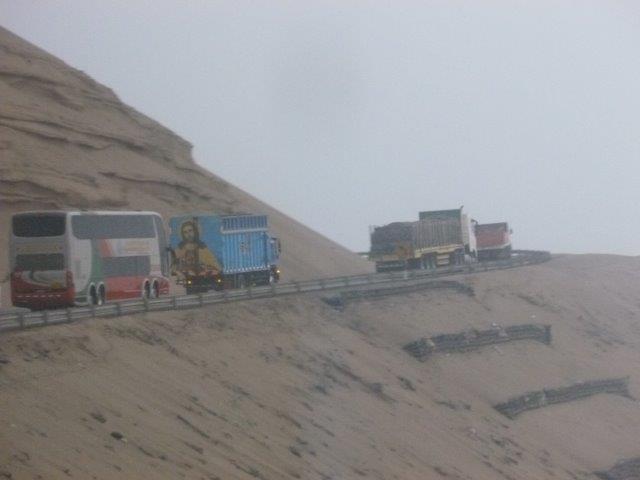
The first two hours of the trip follow the coastline, with enormous eroded sand dunes on the east side of the road that look like they could come sliding down at any minute.


(Yes, that's Jesus waving at us from the back of the truck.  You see a lot of religious imagery everywhere in a country that is officially Catholic.)

We pass the Hari Krishna complex just before the road turns eastward and we start climbing through the high desert.


We occasionally pass an enormous chicken farm or a settlement of families living in makeshift houses (who probably work at the chicken farms).  We see foot trails in the sand where people have walked long distances over the dunes, and "private property" signs placed by mining companies to mark their claims.  There's no vegetation at all as far as the eye can see.

As we begin to follow the course of one of the rivers that flows down from the mountains, we see lots of greenery in the river bed, but the rest of the land remains barren.  Where the river valley is flatter and wider, there are large plantations of sugar cane.


We see many places where corn -- yellow, orange or purple -- is being dried by the side of the road, spread out directly on the rocky terrain.


As we proceed further east, we make the transition from desert to forest.  The hills are still barren at the top, but we see more and more plant life -- first grasses, then bushes and trees.  The last part of the trip proceeds much more slowly, averaging 20 or 30 miles per hour, as we wind our way into the Andes mountains.  The bus driver pauses and honks at each curve of the switchbacks to alert other vehicles that he's about to make a wide turn into the oncoming lane in order to navigate the curve.  

When we're just an hour away, we pass through the high plains where the hills are completely covered with grass -- dead grass since we're in the season when there's almost no rain.  The snow-capped peaks of the highest mountains come into view. 


The bus has arrived on time, and it's just getting dark.  The hotel has sent a taxi to pick us up, and Solano, the taxi driver, greets us with a sign on which he's written my name.  We'll spend the next week deciding whether this will be our new home.

Friday, June 17, 2016

Retiring in Peru

After a long pause -- 7 years! -- I'm finally blogging again.  I retired in May after working as an IT contractor at Eli Lilly for 28 years.  I had been pretty sure since 2005 that I wanted to retire in Peru, for reasons that you'll find in my other posts.  We started planning the move last year, and bought one-way tickets to Lima for May 24 to give us a firm date to work toward.  We put our house on the market in February and found a buyer within 10 days who was willing to let us stay in the house until our departure.

When we decided to make the move, we were most concerned about finding a good school for Marcos, who just finished kindergarten.  So we did a lot of research and found an alternative school in Huaraz that was founded by an American and a Belgian woman, and follows a Waldorf style of "active education".  (More about this school in another post.)

If we like the school and the climate in Huaraz, we'll move there.  We've already reserved a spot for Marcos at the school because we were so impressed by the information that we found on their Facebook page (Semillas de Vida).  But there are a few other schools in other parts of the country that we've identified as possibilities.

The only thing we're absolutely sure about is that we don't want to live in Lima.  It's grown to about 10 million people (the second largest in South America), and the traffic, pollution, and crime have all steadily gotten worse.  Since it's built on a desert and receives less than an inch of rainfall each year, it's been projected to be the first Latin American city that will run out of water.  Public schools were ranked in last place in an evaluation of 63 countries.  Quality private schools cost almost as much as in the U.S., and only exist in areas where housing costs as much or more than in the U.S.

We're staying temporarily at Sonia's mother's house in Lima, while we jump through all of the hoops that are necessary for Marcos and me to obtain permanent residency.  We plan to take a bus to Huaraz (about 8 hours) tomorrow to check out the school and (if it meets our expectations) start looking for a place to live -- initially a temporary place that we will rent while deciding where we want to live permanently.

Thursday, December 24, 2009

Christmas Eve

Christmas Eve - La Buena Noche ("the good night") - is always a day of furious activity here, as everyone makes last minute preparations. Markets are crowded and overflow onto the streets, where many people take advantage of the crowds to sell flowers or cheap imported toys and other gifts.
Turkeys are herded into makeshift pens where they await their fate. Families bring their prepared turkeys to the nearest bakery, where for a few dollars it will be baked to perfection. Families of modest means usually have stoves that use LP gas cylinders. By making use of the bakery oven, they can bake a larger turkey (or pig) than will fit in their own oven, and not have to worry about running out of gas while baking.

Taxis and "motos" are in great demand and can charge higher fees. But many refuse to travel to the inner city, because traffic jams reduce the number of trips they can complete, and expose them to much higher risk of being robbed.

Another oven finished

On Sunday we tested the oven that we completed on Friday, baking a dish of yams. Peruvians eat a lot of yams, both hot and cold, for everything from breakfast to dinner. Here Matías and Alfredo are preparing the stove for its first lighting. At this point we still hadn´t insulated the brick combustion chamber. It needs to be wrapped in fiberglass and aluminum foil to avoid wasting a lot of the heat from the fire.

El Presidente visits my neighborhood

A few days ago the president of Peru, Alan Garcia, attended the inauguration of a new recreational facility for seniors, which had been under construction across the street from my apartment for the past two years. We brought some chairs up to the roof of my apartment and took a few shots. With my camera, that is. I was surprised how little security was provided for him. There were a few dozen soldiers and police with riot gear standing ready. But if I had rented out my roof to terrorists, they would have had an easy shot.

Tuesday, December 15, 2009

Loaning worms in Armatambo


My friend Ana Suyo is always one of the first to know when I´m coming to Peru. She organizes groups of people who are interesting in learning about the energy-saving wood stoves and ovens that I´ve been building during the years that I´ve been working and vacationing here. Sometimes they show up and sometimes they don´t.


During the past week I´ve been teaching a group in Armatambo (a small neighborhood about ten minutes by mototaxi from where we live) to build ovens and stoves. The people are members of the same religious sect that I had worked with before in other parts of the city. Their "invasion" is one of the most recent in Lima, so they´ve had to take whatever land they could find. They settled near the top of a bare, rocky hill. Naturally there is no electricity or water available there yet.


They´re very poor, but very enthusiastic about learning something that will help to improve their lives. They hope to start a small business selling baked products. When we finish building the oven this weekend, I´m going to show them how to make cinnamon rolls. They´re also interested in creating a vegetable garden, but the soil is almost pure sand, so I´m showing them how to make a compost pile. I also found someone who sells worms, and I´m going to loan them 5 kilos of worms, which they can return after the worms have reproduced. They insist on paying for any materials that we use, and have already spent about $25 to build the oven and stove, so I felt uncomfortable asking them to spend another $8 on worms. Hence the loan.


In the last photo, we´re assembling a retained heat cooker from recycled cardboard, plastic bags and bottles. (It's essentially an insulated box where rice or beans can be cooked using their own heat once they've been brought to a boil.) An old lady (second from left) was passing by and when she heard that it was possible to cook without fire, she looked to the sky and said "It's a miracle!". She decided to stay and help us.


We´re Pregnant!

We are happy to announce that a little Wilmes Contreras is on the way, expected to arrive in June. Right now we´re on vacation in Peru, escaping from the cold for a little while before I start my new job at Elanco. We arrived on the 4th and so far we´ve just been relaxing, visiting friends and enjoying some of the great Peruvian food that we´ve missed during the past year. Sonia does her best to recreate Peruvian recipes with American ingredients, but it´s never quite the same. We´re going to try to bring back a few potatoes and some seeds, and try to grow the things at home that we miss most.

It´s finally gotten fairly sunny today, so tomorrow we´ll probably head to the beach.

Wednesday, September 24, 2008

We're married!

Sonia and I were married In Hartford, Connecticut on August 16 in an intimate ceremony with all of our extended family in attendance. The reception was held at the home of Sonia's uncle Benjamin. It was the first time in many years that all of my children and all of my brothers and sister were together at the same time. We enjoyed eating lots of Peruvian food and listening to Latin music.

We left Hartford with a car full of Sonia's clothes and the top layer of our wedding cake on ice in a cooler. (We'll let you know whether it still tasted like cake when we try to eat it next August 16). We drove all day Monday to Canada and spent three days there visiting Niagara Falls and the Welland Locks, and sampling some local food like Guiness Beef Pie and poutine (french fries with gravy and cheese), and the best barbecued ribs that Sonia has ever tasted (of the two times that she has tried them). We each gained a few kilos.
Niagara Falls is very impressive, and the falls on the American side of the border are the largest and pretties (but of course you need to be standing in Canada to see them). The Canadian dollar has now almost matched the US dollar in value (95 cents), so almost everywhere -- except of course the US border crossing -- the exchange rate is 1:1.


We also spent a few days on the coast of Lake Huron but never did find a beach that was sandy enough to go wading in the lake. We arrived home on Saturday exhausted but happy that we had been able to visit some places that neither of us had been.

Sunday, December 23, 2007

Traveling With My Daughter

My daughter Marta recently finished her student teaching and took a break from her North American routine to visit me in Peru for a couple of weeks. We calculated that we spent a total of about 100 hours riding on buses! Fortunately a large part of that took place at night. Our longest single trip was the return from Cusco to Lima, which lasted 26 hours.

After spending a day getting to know Chorrillos, we took off for Huaraz, making tours of several towns and parks in a high mountain valley between the two mountain ranges of Peru. We visited Pastoruri, a popular glaciar at 5000 meters above sea level that is melting rapidly and expected to disappear within eight to ten years.

We found time to visit a zoo in Lima, and Lucy and Walter´s project in Lurin, too, where Marta taught the kids a way to create a simple biographical poem.

Marta managed to stay healthy during the trip (with an occasional dose of ciprofloxacin) but finally succumbed to a bug when she got back home. :-(

Tuesday, November 06, 2007

Quick Tour of Cajamarca

I recently made a trip to the border with Ecuador to renew my visa, as I do every ninety days. This time Sonia decided to accompany me, so we included a little side trip to Cajamarca, a city in the mountains about halfway to the border. It´s the place where Francisco Pizarro and his mob began their conquest of the Inca empire, capturing the Inca king, holding him for a ransom of gold and silver, and then killing him. He and a few hundred soldiers killed the Inca´s five thousand defenders in the main plaza of Cajamarca without suffering a single casualty, thanks to their possesion of guns and horses. It has been estimated that over the next hundred years or so the population of South America was reduced by eighty to ninety percent, mostly because of diseases introduced by the Europeans.

Cajamarca is known as the dairy capital of Peru, and we visited one of the oldest haciendas in the region, where the cows are called by name to come to the trough and eat. (Actually the cows are lined up single file by one person, and another person calls them by name to enter the stall with their name over it. So it´s not as if the cows respond to their name, but they do seem to remember which stall belongs to each of them.)

We also took a couple of scenic tours, one to las Ventanillas de Otuzco (the windows of Otuzco), a pre-inca burial ground which was raided by the Spaniards looking for gold and silver objects that might have been buried with the dead in the small graves carved out of a cliff, leaving thousands of empty graves that now resemble windows. We also visited a regional park in Cumbemayo called El Bosque de Las Piedras (the Rock Forest). Besides having lots of interesting rock formations caused by erosion, it is home to the oldest known aqueduct in the Americas, a nine-kilometer canal carved out of the mountains around 1200 B.C.

Lord of the Miracles

October is known as the ¨purple month¨ in Lima. It´s the time when literally millions of people join processions to venerate a religious icon known as El Señor de los Milagros (Lord of the Miracles). The priests and other VIPs in the processions wear purple vestments. The icon is a replica of a famous painting of the crucified Christ that was made on an adobe wall by a black painter during the sixth century. An earthquake leveled almost all of the buildings in Lima in 1746, but the painting was untouched, and some viewed its survival as a case of divine intervention. Later, according to the legend, a young man who was suffering from an incurable disease went to the wall every day to pray, and was cured of his disease. He then organized a group of people to make weekly venerations at the wall, and over the years the practice developed into the more elaborate processions that now take place every year.

The largest and longest procession takes place on October 28 and 29. It begins in the morning and finishes on the following morning, and follows a simple rectangular circuit in the center of the city, making one detour into a hospital to offer hope to the ill. It covers only a few kilometers because the icon is very heavy (framed in lots of silver and gold) and requires about thirty people to carry the platform on which it sits. Each team of porters slowly walks a few blocks over a period of an hour, then hands it off to a new team. At each change of the guard, the flowers adorning the platform are removed and new ones placed on it. People decorate some parts of the route just hours before the procession arrives, making religious symbols in the street with colored sawdust and flower petals.

A group of veiled women walks in front of the icon carrying incense, and a group of men dressed in purple walks behind the icon. There are several stands set up along the route where the procession stops so that the dignitaries of the organizations who finance the event can be recognized and say a few words. And of course there are ambulatory vendors everywhere, most of them selling turrón, a very dense, dry cake with purple frosting, adorned with lots of sprinkles.


You can stand on one of the side streets and watch the procession go by, or you can take the plunge and join the ocean of humanity walking in front of, alongside and behind the icon. But once immersed in the flow, you pretty much lose control of your movement. Sonia and I decided to join the procession so that I could get closer to the icon and get some good pictures. The crowd pressed from behind, and when the street narrowed it pressed in from both sides. The best we could do was to stay on our feet and try to anticipate curbs and other obstacles, and then plan our exit a block in advance. It was the only time in my life that I feared that I could be trampled. Fortunately we survived the experience and managed to get some good photos.

Monday, November 05, 2007

A Sawdust-Burning Stove

I became interested in sawdust-burning stoves when I saw one in a comedor several weeks ago that hadn´t been used for quite a while. The owner said that the neighbors complained whenever they used it because it produced a lot of smoke. It seemed like a really good idea, since sawdust is at least 5 times cheaper than firewood. I decided to see if I could find a less polluting way to burn it. I found a couple different designs on the internet, the most promising one by a former Peace Corps volunteer. It consists of a metal container (recycled can or cylinder) with a hole in the bottom placed on top of a couple of bricks. A tube is inserted into the hole while you fill the container with sawdust and tamp it down. Then you carefully remove the tube, place a sheet metal donut over the top of it and seal the edges with a little sand or dirt. To light it, you just roll up a sheet of newspaper and light the bottom end. To use it as a stove you have to place a couple of metal bars across the top to support the pot. The cylinder I used is about 10 inches wide and 20 inches high. In my version of the stove, I riveted another, larger diameter cylinder to the one containing the sawdust, so that most of the pot sits down inside the cylinder, improving heat transfer to the pot.

I like my wood-burning bread oven and use it a lot. But sometimes I´d like to be doing other things while my bread or cake is baking. If I´m not monitoring it every four or five minutes and adding wood when needed, it´s impossible to maintain a constant temperature. So I´m hoping to use the same principle to convert my oven to use sawdust, too. But in the sawdust stove above, the diameter of the burning sawdust (and hence the surface area) slowly increases as the sawdust is consumed, causing the temperature to rise gradually but significantly. So I´ve built another version of a sawdust burner to use with my oven. It uses the same type of cylinder, but before packing it with sawdust I insert four triangular metal forms, creating four smaller columns of sawdust each with a constant width. I´ve tested it and it seems to burn at a pretty constant temperature. Now I just have to play with the size of the opening and the height of the sawdust column to achieve the particular temperature that I want for baking.

Saturday, October 27, 2007

Testing The Market For My Cakes

A couple of times a month I´ve made cakes to share with my friends, always with healthy stuff like wheat germ and bran and fruits or vegetables like pumpkin, bananas or coconut, nuts and raisins. Many of my friends have encouraged me to try to sell my cakes, so I decided I would give it a try. I made four cakes -- banana, pumpkin, apple and corn, and I sold sixty packaged pieces in a few hours just by walking around offering them to my neighbors, and I got a request for one whole extra cake. So I think I´ll start doing this every weekend, maybe more often when Sonia finally opens her stand in the market.

4th Anniversary of Lurín Workshop


Last week we celebrated the fourth anniversary of Lucy and Walter´s workshop for kids in Lurín. And a mini-documentary of the workshop was published recently on a web site called No Apta Para Adultos (Not Appropriate For Adults). You can view it at http://napa.com.pe/2007/09/14/napa-16-union-es-fuerza. Just click on the ¨play¨ icon in the video window to start playing the video. The first several minutes of the program are about discrimination against speakers of the Quechua language, and the second part of the program is about Lucy´s kids. It´s all in Spanish, of course, but one thing that´s clear from the video portion alone is how much poise and confidence these kids have developed over the four years that Lucy and Walter and their volunteers have worked with them.

Sunday, October 14, 2007

Census, Peruvian Style

I´ve always said the Peruvians are creative people. But their approach to the 2007 census is one that I doubt any other country has ever used. The last detailed census that produced any information of value was over 20 years ago. It´s always been difficult to get people to cooperate, as they´re suspicious of any government official who comes around asking for personal information. But an even bigger impediment, as you know from my earlier postings, is that they can´t rely on the postal service to implement the census, so the questionnaires have to be done in person. And with many people working six or seven days a week, it´s almost possible to make contact with everyone on the same day.

So someone in the government decided that the they should just paralyze the country for a day, make everyone stay home, and send out an army of volunteer surveyors. And if everything goes as planned, not a person will stir from his or her house between 8 am and 6 pm this Sunday, October 21, except for a serious emergency (unless you work in the airport or a hospital or some other essential service). If you should happen to forget, or not know that it´s census day, your local policeman will invite you to return to your house. Even after you´ve completed your survey, you can´t leave your house. I guess they thought that if they allowed that, many people would just lie about it.

Well, this is just too tempting. I´m going to have to sneak out at least long enough to see whether they really succeed in shutting down the city, and go snap a couple pictures of the deserted streets.

Oh, and the army of volunteers? They figure they need about 600,000. At last count, ten days before the census was to begin, they had a total of just over 200,000.

Tuesday, October 02, 2007

Testing New Stoves for the Comedores

After measuring the pots used in the various comedores, I began looking around in the chatarreros (vendors of recycled stuff) to see what sizes of recycled barrels I could find that would be a good fit. One of the most commonly used pots is 40 cm in diameter, and I found a barrel that is 44 cm, almost a perfect fit after allowing a small space for the smoke to escape. I made a prototype and installed it in the comedor at Huaycan, the one that´s farthest away from where I live but where the people were the most enthusiastic about wanting my help. The stove has an opening at the bottom for feeding the wood, which leads into a brick-lined combustion chamber surrounded by insulation (in this case fiberglass wool, but ashes work fine, too). The pot is supported by a couple of steel rods which sit a few centimeters above the chamber. The hot air hits the bottom of the pot and then flows up along the sides of the pot before escaping from the barrel at the top. The combustion chamber gets very hot because of the insulation and the restricted entry of cold air, so there´s practically no irritating smoke emitted. At the right you can see how they have been cooking over an open fire, with a couple of bricks to support the pot. The new stove will use less than half as much wood as the old one, and it cost about $5 to make. Their current daily expense for wood (cooking three pots at a time) is $1.50, so the stove will pay for itself in just a few weeks.

The group who run the comedor also have a large (2 meter diameter) dome shaped bread oven that they had built to start a bakery. They´ve never gotten it to work well, and they want me to help them with that, too. Unfortunately the oven was built without a chimney, which is probably a large part of the reason that it´s difficult to heat up. We´ve pretty much ruled out modifying it, for fear of damaging it, so I´m going to take along a friend next time who has worked with such ovens for many years. Maybe he can find a way to make it usable.

September Headlines

A lot of interesting things have happened here during the past month. A large meteorite fell near Puno in the southernmost part of the country, leaving a crater 7 meters deep and 20 meters wide. After the local residents got over the shock and disproved the many rumors about toxic fumes and radioactivity coming from the site, they decided to make it a tourist site. They´ve built a fence around it to keep out treasure hunters and they´re going to put a roof over it to prevent erosion. But someone has convinced them that they should bring in a bulldozer and remove the meteor. Whether they´re planning to break it into pieces to sell to the tourists, or put it on display, I don´t know.

There was a referendum in several towns in the department of Piura over whether the residents want a mining company to begin operations there. The result was a resounding NO. A similar referendum was just completed in Ecuador with the same result. The last (and only other such) referendum in Peru produced a similar result despite intensive efforts by both the government and the mining company. This time the government claims that it isn´t bound by the results of the vote because of some technicality in the way it was organized, but a team of 30 international observers say that the voting was conducted fairly. Recently the Interior Ministry has proposed a new law that would make it possible for the goverment to take control over common use lands for purposes of national security. They claim it has nothing to do with the mine, but many suspect that it has everything to do with it, and that shortly the central government will take over the proposed mining site and lease it to the mining company.

Former Peruvian president Alberto Fujimori was finally extradited to Peru by Chile, where he´s been living under house arrest for more than a year after returning to South America with the intention of joining the presidential race. The irony is that the man he ousted from office and exiled from the country, Alan Garcia, is now president of Peru again, having won the election last year. So I don´t think Mr. Fujimori will be getting any breaks.

The long awaited mandatory vehicle inspections which were made law more than 19 years ago have finally become a reality. After years of legal wrangling over how and when and by whom the inspections would be performed, the city of Lima finally opened two processing centers, one in the far north of the city and the other in the far south, each capable of processing about a couple hundred vehicles per day. I don´t know how many vehicles there are in Lima, but there are about 8 million people, so even if everyone rode the buses, I don´t think they could inspect each vehicle once every year at that rate -- and the law requires publlic transit vehicles to be inspected twice per year! But capacity is only one of the issues to be solved. Mototaxis (mini taxis made from converted motorcycles) are also required to be inspected, but they´re not even allowed to drive on the major throughways, so how do they get to the inspection centers? So far the majority of vehicles have failed the tests, which include safety, structural integrity and emissions, Transit companies are complaining about the cost of the inspections and the long waits, but I think what really pisses them off is that they can´t find an inspector who will just accept a couple of extra bucks under the counter to let them pass the inspection.

A formerly unknown tribe of indigenouse people (known here as ¨uncontacted people¨) was observed by a helicopter flying over a region in the Amazon area. The sighting came at a very inconvenient time for a mining company which was in the middle of filing an environmental impact statement for a new development, and had claimed that the area was unpopulated.

Tuesday, August 28, 2007

Whirlwind Tour of Soup Kitchens

I went for a long ride around various parts of Lima with Anita and Sylvia, two members of the religious group that is trying to establish soup kitchens, to see what opportunities there might be to help them save on fuel. We only spent a few minutes at each one, taking pictures and measurements. They were using lots of different fuels -- gas, when they could afford it, kerosene, wood, and even sawdust. They prefer gas because it´s somewhat cheaper than kerosene and a lot cleaner burning, but since one can only buy a tankful at a time (at a cost of about $10), when they´re short on cash (almost always) they have to settle for kerosene, which they buy a liter a time for less than a dollar.

Kerosene is burned in Primus stoves that look sort of like Coleman camping stoves, with a little pressurized tank and a manual pump. (See photo.) In some kitchens they prefer to use wood, but the neighbors always complain about the smoke. To burn sawdust they use a large empty cooking oil can that has a small door cut in one side. They place a large round stick upright in the middle of the container and pack sawdust all around it. Then they remove the log and remove the sawdust between the door and the hollow center, and start a fire in the middle. The door allows air to enter for combustion. Unfortunately the sawdust holds its shape well only if it is slightly wet, and that makes it burn much less efficiently, creating lots of smoke.

During the next few days I´ll develop a strategy for each kitchen (pot skirts, retained heat cookers, high efficiency wood stoves) and start teaching the people how to make and use the devices. The plan is that they will pay for the materials from their fuel savings.