Monday, July 31, 2006

A Fire in the Neighborhood

I heard a lot of sirens on Friday morning, but didn´t realize the fire trucks were just down the street on the block where I live. Apparently a short circuit started a fire in the house and it quickly engulfed the walls, which were made of esteras (woven grass mats) nailed to wooden posts. The family was asleep at the time, but fortunately all awoke and were able to escape.

On Saturday morning, Sonia and I joined about twenty-five members of the church that the family belongs to, digging through the rubble to find anything that could be salvaged and piling all of the debris in one area. When we started, it looked like a forest of burnt poles with wet burned trash everywhere. This is what it looked like after we finished. The part that Sonia and I worked on had lots of straw, and I asked her whether the family kept animals. ¨No¨, she said, ¨those were their mattresses.¨

About the only things that were salvageable were a few tools and a lot of sheet metal roofing. The family is temporarily living in a lot that is owned by some nuns.

Friday, July 28, 2006

Happy Independence Day!


No, I´m not three weeks late. Peru celebrates its independence from Spain on July 28. For most of the people living in 1821, it was only a nominal independence that had no effect on their lives. The wealthy Spanish elite who controlled the country stopped paying taxes to Spain, but everyone else continued to be controlled by the Spanish elite.

In Peru (or at least here in Lima) you´re required to display the flag on Independence Day, and if you have a business you´re required to clean and paint the exterior. You can be fined for failing either obligation. So the city has become quite a bit more attractive during the past few weeks, and flags are visible everywhere.


There´s a big festival in the park across the street where I live, with lots of good food, some games and raffles. I´m heading there right now with some friends.

Monday, July 24, 2006

My New Place -- With A Hot Shower


I´ve finally found an apartment with a large bedroom, a spacious dining room and a tiny kitchen, with a spiral staircase giving me access to the roof. Like most houses in Lima, it has no water heater. The property has a large yard where I can work on developing efficient stoves, ovens and other things that I´m interested in teaching people to produce and to use. And there´s even a large vacant room where I can hold classes.

The owner, Miguel, is seventy years old and a firm believer in lifelong learning. He´s been helping me to find components like recycled barrels for making ovens, and last week we put together a solar hot water shower and installed it on my roof. It consists of a 28-meter coil of 3/4 inch garden hose, painted flat black, beneath a sheet of glass, all encased in a plywood box. The innermost end of the coil is connected to the pipe where the faucet head used to be attached, and the outermost end of the coil is attached to the faucet head. When I open the shower valve, cold water is sent up to the heater, pushing the already heated water down into the shower.

We almost never have a clear day in Lima, especially during the winter (which is right now -- we´re in the southern hemisphere here). On a typical day when it´s about 60 degrees outside and you can´t make out where the sun is, the heater puts out water at about 90 degrees -- just adequate for a shower. On a day when you can see some shadows, the water gets up to 125 degrees. The coil holds only 7 liters of water, but it´s sufficient if you shut off the water while you´re lathering up and then turn it on again to rinse off. It cost about $30 to make using all new materials, but it could probably be made for $10 using recycled stuff.

Wednesday, July 12, 2006

Anniversary Celebration of Workshops


This past weekend we celebrated the first anniversary of Lucy and Walter´s workshops with the mothers of the community of Guadulfo Silva in Lurín, a little town south of Lima. They travel two hours by bus every weekend to provide workshops for the children and their mothers (and a few fathers) about a wide range of topics, including assertiveness training, skills for couples, artesania, and many other things. We´re planning some new activities for the next two years that will include starting a business, perhaps a bakery.


To celebrate the anniversary, the children prepared some dances and skits, Sonia and I cooked aji de gallina, a creamy chicken sauce served over potatoes and lettuce, and some friends of Lucy and Walter played guitars and flutes and sang.


During the celebration, a parade happened to pass by. It appeared to be in honor of el Señor de los Milagros (Lord of the Miracles, one of the many representations of Christ), but included some brightly dressed scissors dancers, a traditional indigenous rite associated with devil worship in the mountains! The large wooden object being carried vertically is a harp.

Wednesday, July 05, 2006

Feast of Saints Peter and Paul

June 29 is the feast of Saints Peter and Paul. It´s celebrated with huge festivals and parades in coastal communities like Chorrillos (where I live) because St. Peter is the patron saint of fisherman.

Vendors line the streets selling food, artesania and clothing. Some of the streets are closed to create a marketplace. On the pier, statues of St. Peter and the Virgin Mary await the procession that will take place in the afternoon. Many people come up and touch them.

Near the beach, people have gathered to watch a couple of street actors. Sonia recognizes one of them as someone who used to have a show on TV, which was canceled because it was considered to be in bad taste. They periodically pull people from the audience to participate in their skits. When I arrive, they call me Harry Potter and proceed to perform a skit about an American who is visiting Lima.

The parade is supposed to begin at 10:00, but at 11:30 we find the streets packed with people, and groups of uniformed participants still trying to organize themselves into a parade. Eventually the parade begins and the people give them enough space to pass. There are army reservists, nurses from a nearby hospital, and groups of students and teachers from all the local schools.


Friday, June 16, 2006

Shopping In Lima

Lima is a huge city (about 7 million people) where the vast majority do not own a car, and public transportation expenses take up a significant chunk of their income. In contrast, almost everyone in the U.S. has a car and the expense associated with it is usually a minor part of personal income. In the U.S., businesses tend to be situated at a distance from other business that sell similar products (with a few exceptions, like restaurants). Here the businesses of one type tend to aggregate in the same area, because people are more likely to shop in an area where they can find lots of choices without spending extra time and money on transportation. When I recently went to shop for furniture, I found dozens of little furniture stores within a couple blocks of each other.

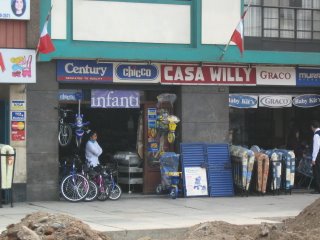
The huge majority of businesses in Peru are very small operations with just a few employees. They operate with very little capital, and their collection of merchandise may have a theme (like cleaning products or kitchen utensils), or it may just be a random collection of things that the owner thought he could sell at a profit. If one business seems to be having a lot of success with a particular item, others nearby may start selling it even if it has nothing to do with the other products that are being offered. For example, here´s a baby products store on a busy street.


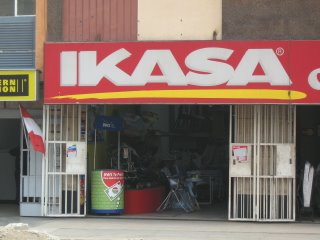
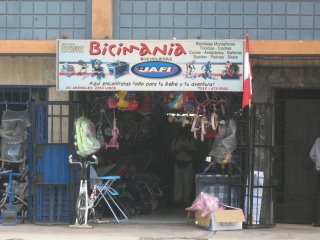
In the same block, there is also a bicycle store, a furniture store and a mattress store. All three of them are now selling baby strollers in addition to the products that you would normally expect to find in their stores.


Unfortunately, some of the areas that offer the best selection of certain products are relatively unsafe. I recently went to buy a recycled stainless steel cylinder to build a stove, and was glad to have two friends with me because it didn´t look like a place where I would want to walk alone.

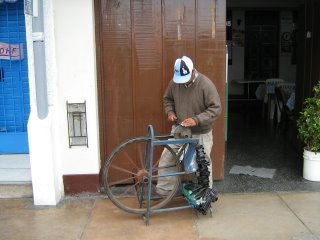
There are lots of ambulatory vendors in Lima who sell products or services. The knife sharpeners are my favorite. They pull a small apparatus that sits on top of a bicycle wheel, and when they stop in front of a home or restaurant to sharpen their knives, the bicycle wheel is operated to power their grinding wheel. They each have a high-pitched flute which they play to announce their presence in a neighborhood, so you always know when they´re passing by. I don´t know how they all ended up adopting the same ¨trademark¨ in a city so huge, but I´ve heard their flutes in lots of different parts of Lima, so I´m convinced that they all use them. Similarly, the trash collectors always bank on the side of their garbage truck with a hollow metal pipe when they come down the street.
Tuesday, June 13, 2006

Peru - A Country Without An Identity

The most striking thing I´ve learned from my classes so far is that Peru is a country that doesn´t seem to have any sense of national identity. From the Spanish invasion in the 1500s, right up until the hacienda system (essentially a feudal system) was abolished in 1968, it has been occupied by two separate societies that didn´t intermix. And even among the indigenous peoples, there is so much diversity that one really can´t think of them as a single society.

There is also a great deal of distrust of the central government in Lima by the people who live in other parts of the country. History has taught them that Lima does whatever serves the interests of the rich people in Lima and the coastal cities, and ignores the needs of the rest of the country. When the national government finally began a significant effort to build highways from the coast to the interior of the country, it did so without any concern for where the population was located. The goal was simply to provide the shortest path to carry metals and minerals from the mines to the coast where they could be shipped abroad.

The regional and municipal governments sometimes do things in defiance of the central government. When the national government decided to go along with the U.S. policy of eradicating coca from Peru, several municipalities in the south whose population were going to be affected by the crackdown declared that coca is part of the patrimony of Peru, and its production cannot be banned.

Contributing to this identity crisis is a distrust among the different segments of society. The Spanish and mestizos in the large cities feel threatened by the huge immigration of indigenous people over the last 50 years, and the indigenous people in the Amazon region feel threatened by the people who have immigrated from the mountains to exploit the resources there by creating farms and cattle ranches. The experience of the Peruvian people over hundreds of years has been that if you trust someone, you will be exploited by them.

I´m often told by my friends here that I´m too confiado, that I trust people whom I don´t know well. I guess that´s because my experience living in North America has taught me that most people can be trusted, and don´t have any reason to harm me. I imagine that it will take a long time for the people here, whose experience is just the opposite, to be able to live together in harmony.

La Senora Teodosia

I went to San Genaro with my girlfriend Sonia and her friend Lucia to visit a women´s cooperative that´s looking for help in locating a new place for their operations. Along the way we stopped to visit a woman I had met several years ago, who was the recipient of a house built by Sonia´s group of lay missionaries. Teodosia lives with her son Fermín near the top of the hill. Somehow they survive on her sales of popcorn and his work as a laborer, for which he is paid $30 per month. She can´t afford the $200 installation charge for an electric meter, so she has to buy her electricity from a neighbor for $8 per month -- a high price to pay for the single bare bulb that illuminates her living room.

On this afternoon she welcomed us and invited us to sit with her in her house, but she seemed distracted. Eventually she told us that her daughter, who lives in the mountains several hundred miles from Lima, was seriously ill. She had received a phone call from relatives a week ago saying that she should come right away, but it would cost $30 each way for the several dìfferent buses and taxis she would have to take to get there. She wanted to bring her daughter to Lima for treatment, because in the area where her daughter lives, the only medical care available is from the curanderos, who have a good knowledge of effective herbal treatments but a poor ability to diagnose many illnesses. Someone had offered her a loan of $15, but she had no way to repay it. We took up a collection among Sonia´s group and were able to give Teodosia enough money for her travels. I´ll check back in a week or so to find out how her daughter is doing.

Monday, June 05, 2006

Where I Live


I´ve rented a small room on the fourth floor of a family house, just across the street from the Lima Sur shopping plaza in Chorrillos, a district in the southern part of Lima. Water is rationed here, and usually lasts from early in the morning till about 6:00 at night. There are three rooms on my floor that share a common bathroom (no hot water). Mine is about two by three meters -- just big enough for a mattress, a clothes closet and some space to store my bags. The floor is concrete and the roof is corrugated plastic, so it gets chilly at night. My friends Lucy and Walter loaned me an inflatable mattress that I´m going to use until I find a more ¨permanent¨ place. But I can´t complain about the price: $46 per month -- including utilities!


From the roof of my building, looking in one direction I can see two hills, San Genaro and Armapampa, both of which were settled by squatters about twenty years ago. The houses are mostly patchwork assemblies of plywood, corrugated metal, plastic, cardboard and woven straw. Few of the them have access to water or sewer services. People either buy water from a truck that comes by every few days or from neighbors down below who have a city water supply and a hose long enough to reach their house. They store their water in large plastic containers. (You can imagine how much water a family would have to store to last a whole week.) In August I´ll be building a pre-fabricated house in San Genaro with a group of Canadian teachers.

Looking in the other direction I can see a gated community across the street from my house, with a beautiful little park surrounded by an iron fence with four entrances, each of them closed and padlocked. Living in this area gives me the sense that no one feels secure. Everyone who has a decent house lives behind at least two layers of locked doors.

My landlord assures me that at the end of the month I´ll be able to move into a larger apartment on the first floor with a small patio and enough room for a kitchen.

Learning More About Peru

I decided to take a class offered by the Instituto Bartolomé de las Casas called Introduction to the Peruvian Reality. It started today and lasts three weeks. It´s oriented toward foreigners who are working in the area of social development in Peru. There are twenty of us in the class, and I think I´m the only student who isn´t associated with a religious order.

There was no electricity at the institute today because someone had stolen an electrical cable a block away. (It´s not uncommon for people to steal electrical or telephone cables and sell them as scrap metal.) So we weren´t able to view the PowerPoint presentations or videos, but I learned a lot about the early history of Peru. The Incas weren´t the ones who invented the impressive agricultural and architectural methods that we still admire today. (No, it wasn´t extraterrestrials, either.) They evolved over several thousand years and several different civilizations that preceded them.

Wednesday, May 31, 2006

A Week With Some Canadians in Cai Cay

I just got back from Cusco, where I spent a week with a group of Canadian students involved in Global Youth Network (http://www.globalyouthnetwork.ca), which coordinates month-long trips to countries as diverse as Peru, Kenya and Burkina Faso for students who want to experience the reality of those countries from the perspective of the people who live there. They typically participate in lots of discussions and volunteer work In this case, I arranged for their participation in the construction of a community workshop at an Una Familia project in Cai Cay, a small town (population 1,000) about an hour from Cusco. We spent most of the week hauling adobe bricks by wheelbarrow from the field they were being produced up to the location where the workshop is being built. We managed to haul 850 of the 4,000 that were being produced, and the group generously donated $400 which should cover hauling the rest of the bricks and erecting the second story of the workshop.

I had lots of photos to share, but my backpack was stolen in the bus terminal as I was leaving Cusco, and I lost my camera, passport, and some other things. So it may be awhile before I post any more photos.

Monday, May 15, 2006

A Week in England With My Daughter

I spent the first week of May visiting my daughter Marta, who´s spending a semester abroad at the University of Sussex. We spent most of the weekend traveling around the southern part of England.
This is Westminster Abbey, probably the most beautiful building I've seen in all of my travels.

This is the changing of guard at Buckingham Palace.
This is a building in Brighton built by one of the kings.


For me the highlight of the trip was a visit to the Eden Project, the largest plant conservatory in the world.


We also walked around the moors one day and visited a fourteenth century church that we found on top of a hill.


This is my daughter. She´s completely mastered dressing like a Brit, but still has some work to do on the accent.

Another Adventure in Latin America

I´m taking one more step toward figuring out what I want to be when I grow up, spending about eight months in Peru working on various social development projects. The non-profit organization that I started four years ago, Una Familia, has been supporting three projects here, near Lima, Cusco and Trujillo. They are all very different, involving health, education and security, but what they all have in common is empowerment of people to create a better life for themselves and their children.

As many of you know, I´ve been trying for the last several years to make a transition from doing what I´m good at (software engineering) to doing what I love to do (international development). I happened to bring along a book of poems by Robert Frost, and these lines from the end of ¨Two Tramps In Mud Time¨ seem to describe what I´m trying to accomplish in my personal life.

But yield who will to their separation,
My object in living is to unite
My avocation and my vocation
As my two eyes make one in sight.
Only where love and need are one,
And the work is play for mortal stakes,
Is the deed ever really done
For Heaven and the future´s sakes.